
3 Proven Vegan Fitness Tweaks to Skyrocket Your Results
If you are having any trouble gaining muscle on a vegan diet, there are 3 possible causes...
If you've experienced any difficulty building muscle on a vegan diet, there are three possible causes:
You aren't eating enough
You're doing too much cardio
You're lifting too little or too much (yes, overtraining kills gains!)
I should note that none of these issues are inherent to vegan bodybuilding specifically, but rather plague lifters from all dietary backgrounds. Still, this article is specific to vegan bodybuilders, so let's dive into each one of these muscle-building pitfalls to make sure you keep making those vegan gains! 🌱 💪
Muscle-building pitfall #1: You aren't eating enough
Generally speaking, whole plant foods are less calorie dense than their animal product counterparts. And if you aren't in a caloric surplus, meaning you are consuming more calories than you burn each day, then your body will not be able to gain muscle.
Some research and anecdotes claim that beginner bodybuilders can both gain muscle and lose fat on a caloric deficit, but I don't have experience with this. However, I know for sure that anyone with a year of serious lifting experience can't make calorie-restricted "newbie gains."
So, when working to gain muscle, you must maintain a caloric surplus, but limit yourself to no more than 10 percent beyond your basal metabolic rate (BMR, or the amount of energy your body burns by simple being alive) plus activity burn (the amount of additional energy you burn from movement and exercise). In other words, you don't want to eat more than 110 percent of the calories you burn each day.
Hitting your numbers without going overboard will require you to (approximately) track your calories, both the calories you burn and the calories you consume. Once you track your calories for a few weeks, you'll get a pretty good idea what foods and portions you should be aiming for.
As for protein, my standard advice for protein intake when bulking is 0.9 grams of protein per pound of body weight per day to optimize the muscle building potential of your diet. Click here to learn Everything You Need to Know About Vegan Protein, and read the studies upon which I base my protein intake advice.
As a vegan, I'm sure you are concerned about eating healthy foods packed with nutrition, not just foods that build muscle. Unfortunately, most of the healthiest foods in the world are nutrient dense, but not calorie or protein dense. For this reason, you must use careful meal planning to maintain a caloric surplus and hit your higher-than-normal protein intake needs with a whole food, plant-based diet. My secret is that I drink my micronutrients instead of consuming monstrous salads that fill me up and take forever to eat.

Here's my micronutrient-packed Berry Ginger Kale Smoothie Recipe that allows me to check off more than HALF the boxes from Dr. Greger's Daily Dozen list. I sip a half gallon portion (64 oz.) throughout most mornings.
Note: Non-extractable polyphenols, potent micronutrients in plant foods that defend our bodies against degenerative diseases such as cancer and cardiovascular disease, form the majority of dietary polyphenols. In plant foods, these health-promoting polyphenols are stuck to dietary fiber. In other words, no fiber, no polyphenols. As such, juicing fruits and vegetables removes fiber and the plentiful polyphenols that bind to it. These findings suggest smoothies are preferable to juicing in maximizing micronutrient intake.
Muscle-building pitfall #2: You're doing too much cardio
I understand you want to stay lean while building muscle mass. So do I. Unfortunately, doing too much cardio fatigues your muscles, further breaking down muscles in need of repair after tough resistance training.
In a recent study, researchers divided 30 resistance trained men into 4 groups and they completed a 6 week training program in which they trained 3 days per week.
Group 1: Only strength training 3 times per week
Group 2: Strength training 3 times per week and endurance training (treadmill running) once per week
Group 3: Strength training 3 times per week and endurance training (treadmill running) 3 times per week
Group 4: Didn't train at all (control)
At the end of the program, Group 1 and Group 2 had the highest lower body strength increases, but Group 1, the strength only training group, had a significantly higher lower body power increase than all the other groups. Upper body strength increased similarly in Groups 1-3.
What do these findings tell us?
If muscle growth and strength are the primary goal, then you should keep cardio to a minimum
Interference between endurance training and resistance training is a local process. In other words, lower body-focused cardio like running has a negative effect on lower body muscle and strength gains, but doesn't affect upper body muscle and strength gains.
Thankfully, you can stay lean while building vegan muscle with a whole food vegan diet, heavy compound lifting, and some high-intensity interval training (HITT). Honestly, I only do HITT during the spring and summer months to shave off a few extra body fat percentage points. I've found that I can lean bulk quite well with a healthy diet full of whole plant foods like rice, potatoes, lentils, beans, and broccoli.

If your cardiovascular health is the main reason you do cardio, then 5-10 minutes of HITT per day, plus a diet free of cholesterol and little-to-no saturated fat will do the trick.
Just to clarify, I really enjoy hiking, mountain biking, and drumming, all activities that require serious movement and could be considered as "cardio." I'm not suggesting you stop doing physical activities you love. I'm just saying that you shouldn't slave away on a treadmill every morning because it hinders muscle growth.
Muscle-building pitfall #3: You're lifting too little or too much
You build muscle by damaging your muscles. This seems counterintuitive, I know, but allow me to explain.
Skeletal muscle is made up of long fibrous chains containing proteins. Bundles of thousands of fibers make up the muscle itself. When you engage in a heavy workout, you damage your muscles, causing microtears in the muscle fiber.
The body naturally repairs microtear damage by mending the torn fibers using amino acids, the components of protein your body synthesizes on its own and from food.
It takes about 48 hours for your muscles to repair themselves after a hard workout. This recovery process is known as cellular repair. The result is a muscle that is larger and stronger than before.
To cause microtear damage to your larger, stronger muscles, you must gradually increase the exercise-induced stress your muscles experience (i.e. lifting heavier and heavier weights over time). This gradual weight increase over time is called progressive overload.
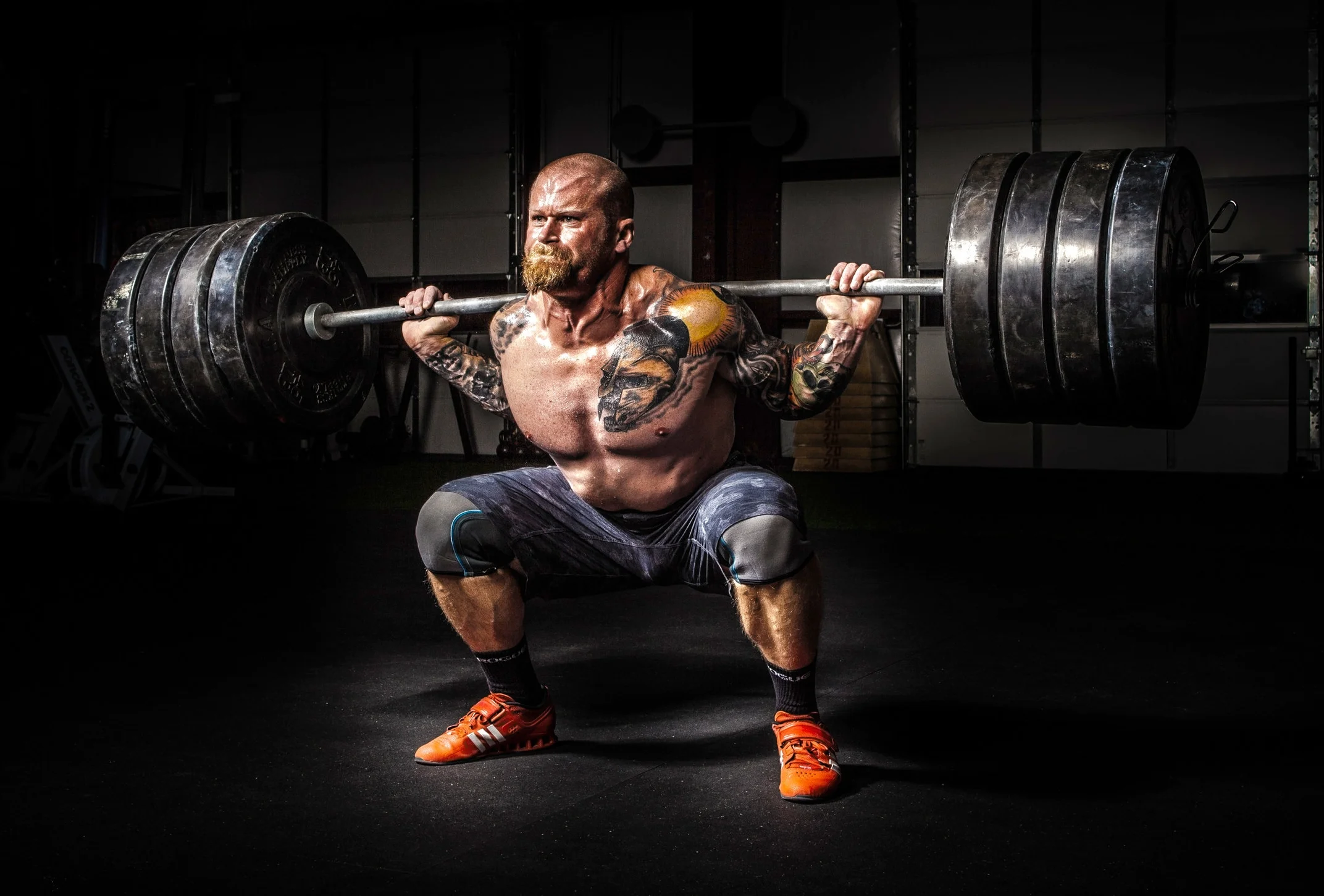
The Progressive Overload Principle
The progressive overload principle is the most important rule of natural bodybuilding. In order for muscles to grow in size and strength, they must be forced to adapt to a tension that is heavier than anything previously experienced. In other words, you must lift heavier and heavier weights over time as your body becomes stronger and your muscles become bigger.
Therefore, you MUST emphasize heavy compound weightlifting in your workouts to gain serious muscle and strength.
What exactly is a compound exercise? A compound exercise is an exercise that involves multiple joints and muscle groups.
Because compound exercises employ multiple muscle groups, they allow you to lift heavier weights through a wide range of motion and therefore better progressively overload your muscles.
If you want more information on what kind of exercises I do, check out my typical weekly workout routine and list of favorite exercises.
Volume is the total number of repetitions (reps) lifted over a specific period of time (usually a week).
If your volume per week is too low, you will struggle to gain muscle and strength. Remember, the goal is to progressively overload your muscles to gain size and strength. You can't progressively overload your muscles with a few squats, pullups, bench presses, and deadlifts per week.
If your volume per week is too high, you'll run into serious problems with overtraining and push your muscles beyond repair.
Get the volume right, and you'll make gains faster than ever!
If you want to learn all everything you need to know about hypertrophy (the technical term for muscle growth), download your free copy of my 35-page Complete Guide to Building Vegan Muscle. I promise it will blow you away!
That's a wrap! Thank you so much for reading this article!
Was this article helpful to you? Please be sure to "like" 👍 this article by clicking the heart below and consider sharing it with your vegan bodybuilding friends!
What difficulties have you encountered with vegan bodybuilding? Please tell us in the comment section below! 👇 We'd love to help you!
Your vegan fitness trainer,
Leif

The 5 things I wish I knew when I started vegan bodybuilding (most vegans DO NOT agree with #2!)
These are the 5 lessons that skyrocketed my results in the gym. Unfortunately, I didn't know them when I first started on my vegan bodybuilding journey. If you want to accelerate your vegan muscle and strength gains, you MUST know these 5 lessons.
"The road to nowhere is paved with excuses." - Mark Bell
1) You can gain muscle just as easily as meat-eaters...BUT you MUST have a solid nutrition plan
To get bigger and stronger, you need to do four simple things:
Do the right exercises
Lift progressively heavier weights over time
Eat nutritious foods and consume enough protein
Give your body sufficient rest
A proper nutrition plan is crucial to building muscle, but it doesn't really matter if you eat meat or follow a vegan diet, your muscles don't really care as long as they are getting enough amino acids to repair the micro-tear damage you cause at the gym.
2) Protein is CRUCIAL! (Anti-protein vegans don't make gains!)
There are many solid, scientifically-backed arguments against consuming high-protein diets. Unfortunately, there is simply no way around eating a lot of protein when you are trying to gain muscle and strength.
Research indicates that the optimal level of protein intake for muscle mass, strength, and athletic performance is approximately 0.75 grams per pound of body weight. Click here to read Everything You Need To Know About Vegan Protein, where I cite these studies.
My standard advice for protein intake when bulking is 0.9 grams of protein per pound of body weight per day. When cutting, you should consume around 1.1 grams of protein per pound of body weight per day.
These numbers are slightly higher than the recommended values in the cited studies because the digestibility of plant protein is about 10 to 30 percent lower than animal protein, depending on the food. Overall, animal protein is more easily absorbed and assimilated into your body. Animal proteins contain more essential amino acids (EAAs) per gram and are more easily digested and absorbed. To my knowledge, there are no studies analyzing the daily protein needs of athletes on a plant-based diet.
This does not mean that plant protein is in any way inadequate or even puts vegan bodybuilders at a disadvantage to their omnivorous counterparts. But as vegans, we do need to plan our protein consumption a bit more carefully.
To hit 0.9 grams of protein per pound of body weight on a vegan diet, you'll likely want to supplement your diet with vegan protein powder.
Click here to read the Ultimate Vegan Protein Powder Review. I'll tell you exactly what my favorite protein powders are and other options that you might like as well.
I like rice and pea protein sources because they’re similar to animal protein in terms of amino acid profile and protein digestibility. Rice protein mixed with pea protein yields an amino acid profile similar to whey protein.
While soy is the most popular vegan protein powder on the shelves and it is an all-around effective source of protein for building muscle, I tend to avoid it. To maintain the low IGF-1 levels associated with a plant-based diet, one should probably eat no more than 3-5 servings of soy foods a day. Furthermore, soy is often genetically modified to produce greater crop yields. Some research also suggests that soy has a negative effect on hormone levels for men.
Hemp protein is also popular, but a relatively poor choice when compared against rice, pea, or even soy protein. While hemp boasts a great micronutrient profile, including omega-3 and omega-6 fatty acids, hemp is only about 30 to 50 percent protein by weight. Furthermore, the protein is does contain isn't nearly as digestible as rice or pea protein.
3) The Protein Absorption Myth is just that...a myth!
A common recommendation by so-called "experts" is to consume no more than 30 to 40 grams of protein per meal, as more will be discarded for the body or stored as fat. This theory is what I call The Protein Absorption Myth.
Well, it is totally false.
Protein needs and absorption rates vary due to a person's lifestyle and lean muscle mass. There is no one-size-fits-all maximum protein absorption amount.
Think about it. A 220 pound bodybuilder and 120 pound weakling cannot possibly have the same protein metabolism rate, right? Obviously.
Beyond intuition, we have studies to prove it. Researchers analyzed protein metabolism of subjects who consumed all of their daily protein within 2-4 hour feeding windows to analyze the effects of the dietary approach called "intermittent fasting." The researchers concluded that consuming large amounts of protein within a small window of time does not affect protein metabolism in any way (source).
Note: I use this study to make a point, I do not advocate intermittent fasting, but know many ripped fitness experts (Greg Gallagher in particular) who swear by it.
4) You MUST focus on HEAVY, COMPOUND LIFTS
When I started lifting at the age of 17, I made a lot of mistakes. I did a lot of long (2+ hour) high-rep workouts consisting mainly of isolation exercises. These workouts were incredibly boring and I never looked forward to going to the gym.
When guys spend a couple hours in the gym pounding away with drop sets, burnout sets, supersets, and so forth, they're working very hard for little payoff.
What these guys and I didn't realize is that you maximize muscle and strength gains by focusing on heavy, compound lifts. These exercises are the "non-negotiables," which are exercises you should do every week, without fail. The big compound lifts vital for building a strong, muscular physique are the squat, deadlift, bench press, and military press.
Leave the drop sets, giant sets, and supersets prescribed in the magazines to the magazine readers. These training methods are as ineffective as they are grueling.
That being said, a well-designed weightlifting routine for strength and aesthetics includes both compound and isolation exercises.
Compound movements comprise about 75 percent of the exercises I do in the gym. The other 25 percent are isolation exercises.
5) Proper rest is just as important as proper training
One of the most common problems with weightlifting programs is excessive training. While many guys undertrain in the gym because they’re too busy checking themselves out in the mirror and scrolling through Facebook, there are also many guys who overtrain.
Your muscles can only take so much of a beating every week before your body falls behind in its ability to repair the damage caused by training. Training frequency alone does not determine much in the way of gains.
Instead, VOLUME is the important metric. Volume, or the total amount of total reps performed, is the main determining factor in your muscle and strength gains.
If your volume per week is too low, you will struggle to gain muscle and strength.
If your volume per week is too high, you’ll face problems related to overtraining (more on this later).
Get the volume right and you’ll make gains faster than ever.
If you want to learn all everything you need to know about building vegan muscle, download your free copy of my 35-page Complete Guide to Building Vegan Muscle. I promise it will blow you away!
That's a wrap! Thank you so much for reading this article!
Was this article helpful to you? Please be sure to share this article with your vegan fitness friends by clicking the share button below! I'd really appreciate it and so would your friends!
Are you just starting out on your vegan weightlifting journey? Please post any specific questions in the comment section below and I'll answer! 👇
Your vegan fitness trainer,
Leif
Struggling to stay healthy? Here's how to do it...
Your body is a masterpiece that stands brilliantly unique in a world of 7 billion people. The mere fact that you are alive and your body is functioning in harmony is beyond remarkable. Every minute, your body completes billions of complex chemical reactions that make college chemistry look like kindergarten art class. Here's some AMAZING facts about our incredible bodies...
Your body is a masterpiece that stands brilliantly unique in a world of 7 billion people. The mere fact that you are alive and your body is functioning in harmony is beyond remarkable. Every minute, your body completes billions of complex chemical reactions that make college chemistry look like kindergarten art class. Here's some AMAZING facts about our incredible bodies...
If the human brain were a computer, it could perform 10 thousand-trillion operations per second. The world's most powerful supercomputer, BlueGene, can manage only .008% of that. (source: How Stuff Works)
Your body produces 23 million new cells each second. Every 14 seconds, you produce more cells than there are people in the United States. (source: ASU)
In one day, your blood travels 12,000 miles around your body. That's four times the distance across the US from coast-to-coast. Red blood cells can travel your entire body in roughly 20 seconds. (source: Viral Nova)
Your heart beats about 100,000 times per day and about 35 million times per year. (source: PBS)
Are you really going to thank this loyal, finely-tuned machine that breathes, beats, and fights to keep you alive every second of the day by living a sedentary lifestyle and eating unhealthy, even toxic, food?
Your body needs regular activity, vitamins, minerals, macronutrients, amino acids, and lots of water to function properly. Show a little appreciation for your amazing body by cutting out the processed garbage, filling your plate with wholesome food, and staying active.

A friend recently asked me, "How do you maintain such a healthy lifestyle?" My initial response was, "Where do I even start?!" Maintaining a healthy lifestyle isn't rocket science, but too often people get caught up in the latest diet fads and exercise DVDs that promise life-changing results with a swipe of your credit card and three easy payments. To ensure a sustainable healthy lifestyle, I believe we all must start with a more fundamental approach that, when used purposefully, will transform your life.
So here is my not-so-secret secret...I maintain a healthy lifestyle using my DRIVING FORCE, MINDSET, and KNOWLEDGE.
Everyone knows the fundamentals behind living a healthy life: getting plenty of physical activity and eating a balanced, wholesome diet full of fruits and vegetables. So why do so few of us fail to put this into practice?
We haven't taken the time to give ourselves a strong enough DRIVING FORCE to overcome our endless list of excuses. Your driving force is the reason, or reasons, that will push you to take action in any area of your life. Your driving force is undeniably the most important part of maintaining a healthy lifestyle. Here are some examples of strong driving forces:
An overweight parent decides that they no longer want to see their child playing soccer by herself in their backyard.
A fast food regular learns from his doctor that he is pre-diabetic and at serious risk for heart disease.
A couch potato decides that she is going to drastically change her diet and begin training for a local 5K so she never again fears fitting in an airplane seat.
A thin, non-athletic man looks at his frail figure in the mirror every morning and envisions himself becoming a ripped fitness magazine cover model.
The stronger your driving force(s) the stronger your will and the more definite your action. If your desire for an extra side of fries exceeds your desire to live a long, fit, healthy, disease-free life, then forget it. You won't change your ways until a strong enough driving force presents itself. Your driving force all starts with a realization that you are not where you want to be with your health at this time in your life. You need to accept that you have momentarily faltered, maybe numerous times, but you have NOT failed. Once you realize and accept where you are, you need to understand where you want to go and begin taking small steps toward making this destination your reality.
Long-term healthy living cannot be based on deprivation. You have to re-train your MINDSET. It is not about denying yourself a slice of cheesecake for dessert, it is about preferring to eat a bowl of fruit because you love the fresh, clean taste and you love the way it makes you feel nourished and invigorated. I eat healthy foods because I want to, not because I have to.
After developing the right motivation and mindset for taking action to improve your health, you need KNOWLEDGE of the tried and true principles behind healthy living. Too often people fall into the traps of gimmicks such as 10-minute six pack videos, magic fat burning pills, and expensive dieting fads.
You must stop hiding in ignorance and take control of your health with the power of readily-accessible information. Ignorance is NOT bliss, especially when your health is on the line.
Summary
1. Take time to audit and accept where you are right now in terms of your health. This is the first step to effect change. You have the power to change!
2. Don't think about health in terms of "I have to..." Think instead in terms of "I want to..." "I feel grateful for..." and "I enjoy..."
3. Research healthy eating using reputable sources providing information backed by evidence - no gimmicks! Here are some great resources to get you started:
4. Remember, healthy eating cannot be based on deprivation. The path to true health does not require calorie counting, but you must be consuming wholesome foods.
TAKE MASSIVE ACTION NOW
Here are 3 action steps to jumpstart your healthy lifestyle. Please be sure to download, print, and complete the PDF version (click here: MASSIVE ACTION WORKSHEET) to stick somewhere you will see it often (on your refrigerator, mirror, desk...).
ACTION STEP 1: Ask yourself the following questions. This self-audit will help you understand where you currently are and how you should start working toward your goals.
What are the driving forces that will push me to take action?
What are my 3 main health/fitness/wellness goals
Are you on track to achieve them?
Are you satisfied with your diet?
How much enjoyment do you get from your diet?
If someone asked you why you eat and live the way you do, what would your answer(s) be? Do you feel good about these answers?
ACTION STEP 2: Ask for advice and guidance. It is very likely that you know someone who leads a healthy lifestyle. It doesn't hurt to ask them questions! Simply start a conversation by saying, "Hey _______, you seem to have an effective approach to maintaining your health and fitness, would you mind telling me how you got started?" A simple compliment and request for advice delivered with genuine interest will get you very far!
ACTION STEP 3: Cultivating the right mindset requires accountability, both to yourself and to a trusted individual or group of individuals. To stay accountable, you need to set measurable goals, but you can't keep these to yourself or you can easily talk yourself out of pursuing them. Instead, you must declare them publicly to hold yourself accountable. In order to make this successful, you will have to stay in close contact with your accountability partner(s). It will only require a 5-minute email or phone call daily.
I'll leave you with one final thought: healthy living does get easier and more enjoyable with time! Do your best to get started and let the positive momentum bring you great health and happiness!
Here's to your health,
Leif